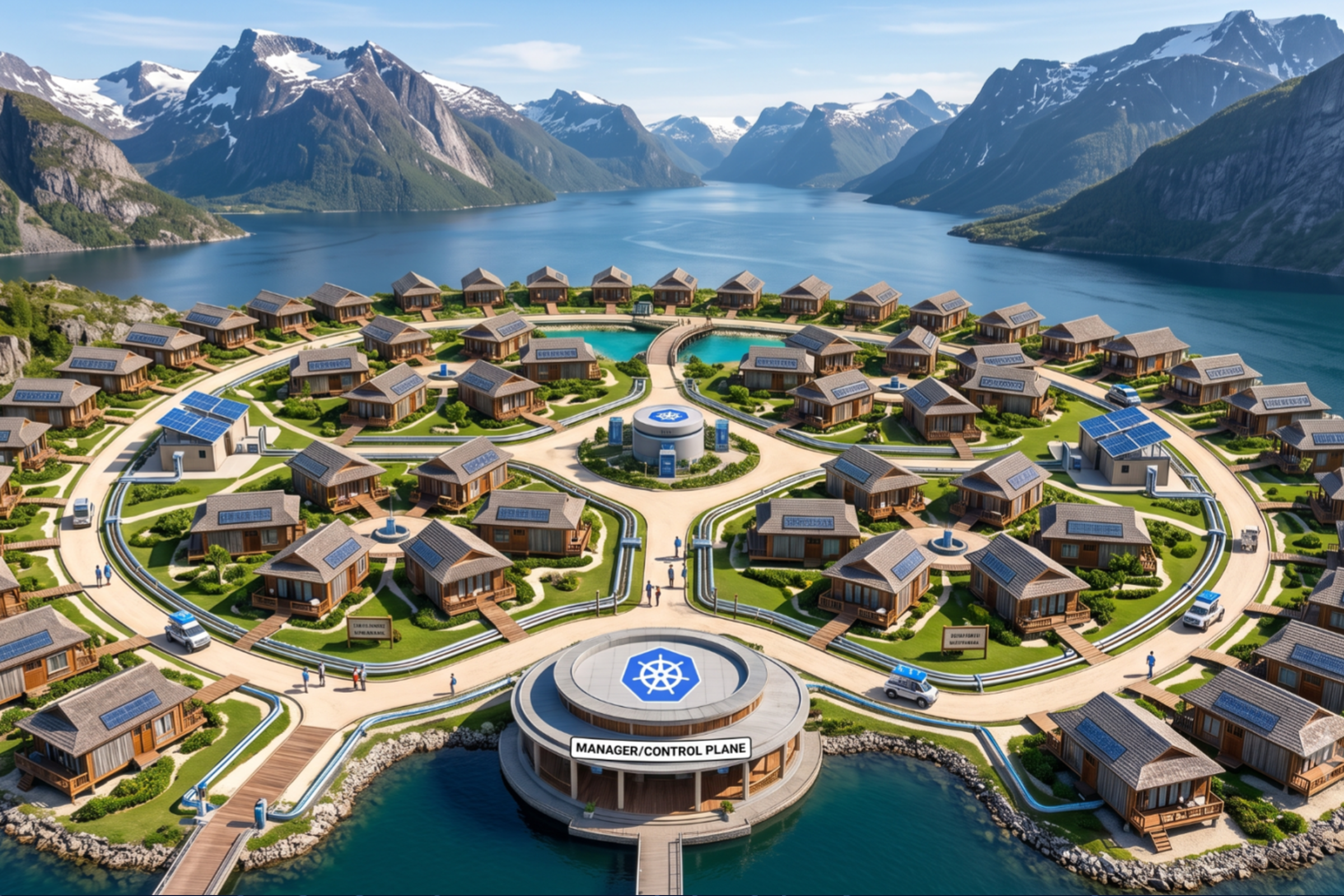

Let’s dive into the world of cloud hospitality management!
The Starting Point: Why We Need a Hotel
In the past, companies built software like a giant, massive castle (a monolith). If the heating system broke down in the basement, the entire castle came to a standstill. Today, we build microservices: every single function of the software (e.g., login, invoice printing, search) is its own small, independent bungalow.
We call these bungalows containers. They are easy to build, quick to replace, and don’t interfere with one another. But who manages a resort with hundreds of bungalows? Enter: Kubernetes. The tireless hotel manager.
The Infrastructure: Where Is the Hotel Located?
Before the first guests can move in, the hotel needs a foundation. There are two main approaches here:
The Managed Hotel (e.g., Cloud Providers): You rent the plot of land and the basic foundation from a massive tech giant. If a main water pipe bursts, the landlord takes care of it. You focus purely on making sure the rooms are beautifully furnished.
The “Bare Metal” Hotel: The engineers go out into the woods themselves, chop down the trees, mix the concrete, and build the hotel directly on the raw ground (bare metal). They have maximum control over every single screw, but they also have to head out themselves in the middle of the night if the sewage treatment plant fails.
Automated Structural Shell via 3D Printer (IaC)
In a modern IT hotel, nobody clicks rooms together using a mouse anymore. Instead, Infrastructure-as-Code (IaC) is used—currently often with tools like Terraform. Think of it like a gigantic 3D printer. You feed it a digital blueprint (code) and press start. The printer automatically pours the foundation, raises the walls, and connects the hotel to the street. Exactly according to plan, without any human error.
Interior Design via Shopping List (GitOps)
The hotel is standing, but the rooms are empty. This is where GitOps comes into play. This is the principle by which the hotel continuously reconciles itself with a digital shopping list. The list states: “Room 101 needs a bed, a TV, and a minibar.” If a guest destroys the bed, the system notices it immediately, checks it against the shopping list, and automatically sets up a new bed. The hotel manager ensures that the actual state always matches the desired state.
The Room Designers: Who Builds the Windows and Where Is the Light Switch?
So far, we have only talked about the foundation, the walls, and the logistics of the hotel. That is the job of the platform team. They provide the functional, secure structural shell of the building. But a hotel without charm and functionality won’t attract any guests. This is where the application developers come in.
While the platform team lays down the electrical wiring, the developers decide what the bedside lamp looks like and where exactly the light switch is placed so that the guest can find it instantly in the dark.
The Windows and Design (Frontend): The frontend team takes care of what the guest sees and touches. They build the large panoramic windows (the user interface), choose the wall colors, and design the menus of the hotel app to make booking a pleasant experience.
The Background Room Service (Backend): When a guest presses the button for room service, they don’t see what goes on in the basement. The backend team builds the invisible logic: How quickly is the order forwarded to the kitchen? How is the room bill calculated correctly?
The Room Configuration: The developers determine the fine details of the rooms. They pack the software features into so-called Helm Charts. These are essentially the detailed interior design plans for every single bungalow. They specify: “In this room, the sofa is white, the cushions are blue, and the television automatically starts on channel 1.”
The platform team ensures that the hotel has electricity, water, and a secure roof. The application developers make sure that the stay is a fantastic experience for the guest. Only through this teamwork does the hotel truly come to life.
Security: Bouncers, Secret Passages, and Laser Barriers
Unfortunately, a hotel doesn’t just attract well-behaved guests. That’s why the security architecture is crucial:
The Bouncer (WAF – Web Application Firewall): They stand right at the main entrance. If a guest arrives with a knife hidden up their sleeve (malicious code), they are thrown out immediately before they even reach the reception desk.
The Invisible Tunnels (Private Endpoints): The most critical rooms, like the vault in the basement (the database), have no windows facing the street. You can’t even see them from the outside. Trusted suppliers can only access them via opaque underground tunnels running directly to the destination.
The High-Tech Laser System (Cilium): Even inside the hotel, a healthy dose of skepticism prevails. The network system (e.g., Cilium) monitors the hallways. Why should the minibar suddenly try to talk to the personnel files at the front desk? The laser system detects this unauthorized movement and blocks it instantly.
The Emergency: When the Rental Clowns Arrive (DDoS)
What happens during a DDoS attack? This isn’t a digital break-in where data is stolen. Instead, it’s as if an attacker sent 10,000 rental clowns to your hotel all at once. The clowns clog up the access road and storm the reception desk at the same time. They repeatedly ask the staff every single second: “Do you have a room available? What time is it?” The receptionists (the CPU processing power) become so overwhelmed that the real, paying guests leave in frustration because they can no longer get a keycard. A strong security presence outside the premises ensures the clowns are filtered out before the hotel collapses.
Conclusion: Who Runs the Hotel?
Behind every great, automated hotel sits a platform team. Their job is not to write the software features themselves (that is done by the application developers). The platform team sets the stage. They ensure that the 3D printer runs, that contracts and security certificates don’t expire, and that the hotel remains stable.
Once the system is set up correctly, this hotel runs like a Swiss watch. Fully automated, secure, and ready for any rush of guests.