
Argo Workflows addresses this as a container-native workflow engine: this post explores how DAGs, data pipelines, and complex batch jobs can be implemented declaratively and transparently on Kubernetes.
The Problem: The Limitations of Simple Kubernetes Jobs
Kubernetes provides solid fundamentals with Job and CronJob resources to run one-off or scheduled tasks in containers. Once a workflow grows beyond a single Pod, the built-in Kubernetes primitives become limiting.
Typical real-world challenges:
- Missing dependencies: Task B must not start until Task A has completed successfully. Out of the box, K8s Jobs offer no way to represent such dependencies.
- No data and artifact passing: Intermediate calculation results (e.g., a processed file or a generated ID) cannot easily be passed from one Pod to the next.
- Lack of error handling: If a single step in a multi-stage chain fails, the entire process often has to be restarted from scratch because fine-grained, per-step retry logic is missing.
- Lack of visibility: With dozens of parallel running Pods, standard K8s views quickly lose clarity on where a pipeline is currently stuck or blocked.
At that point, many teams turn to wrapper scripts, external CI/CD tooling, or custom orchestrator services.
The Solution: What is Argo Workflows?
After presenting Argo CD for state (Desired State) in part one and Argo Events for signals (Triggering) in part two, Argo Workflows takes on the third core building block of the platform: the execution of complex, multi-stage logic.
You can think of Argo Workflows like an automated production line in a factory: a raw material arrives and passes through various specialized stations one after another. If needed, the assembly line splits up for parallel processing steps, brings intermediate products back together at an assembly station, and hands off the final result to the warehouse. Each station works in isolation, yet is precisely coordinated with the preceding and following steps.
Argo Workflows is a native, open-source workflow engine for Kubernetes. Every step in a workflow runs in its own isolated Pod. This gives each step independent scaling, custom resource sizing, and declarative YAML control.
The Architecture: The Key Building Blocks
Argo Workflows is based on a few powerful Custom Resources that structure complex process chains:
- 1. Workflow: The central object that defines and starts a concrete execution of a pipeline.
- 2. WorkflowTemplate: A reusable template (blueprint) for processes that can be parameterized and called from various systems.
- 3. Steps vs. DAGs (Orchestration Logic):
- Steps: Sequential or simple parallel lists of steps (Step A -> Step B -> Step C).
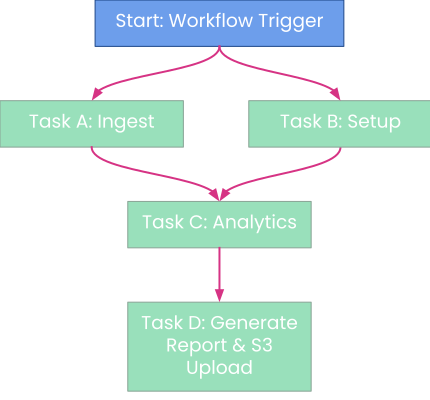
- DAGs (Directed Acyclic Graphs): Graph-based dependencies. Steps are executed based on directed graphs (e.g., “Execute Task C as soon as Task A and Task B have completed successfully”).
- 4. Parameters & Artifacts: Control the data flow. Parameters pass strings and environment variables; artifacts transparently pass entire files or folders (e.g., via S3/MinIO) from one Pod to the next.
DAG Workflow Sequence
A Simple Example: A DAG Workflow in YAML
Prerequisite: The Argo Workflows CRDs and controller must already be installed in the cluster. An
argo-workflowServiceAccount must be created, and the following ClusterRole grants authorization for workflow execution.
apiVersion: rbac.authorization.k8s.io/v1
kind: ClusterRole
metadata:
  name: workflow-executor-rbac
rules:
  - apiGroups:
      - argoproj.io
    resources:
      - workflowtaskresults
    verbs:
      - create
      - patch
The following example shows a DAG workflow where two tasks (task-a and task-b) run in parallel before the final task (task-c) starts.
apiVersion: argoproj.io/v1alpha1
kind: Workflow
metadata:
  generateName: dag-pipeline-
  namespace: argo
spec:
  serviceAccountName: argo-workflow
  entrypoint: main-pipeline
  templates:
  - name: main-pipeline
    dag:
      tasks:
      - name: task-a
        template: worker-step
        arguments:
          parameters: [{name: message, value: "Loading data from source A"}]
      - name: task-b
        template: worker-step
        arguments:
          parameters: [{name: message, value: "Loading data from source B"}]
      - name: task-c
        dependencies: [task-a, task-b]
        template: worker-step
        arguments:
          parameters: [{name: message, value: "Performing aggregation after A and B"}]

  - name: worker-step
    inputs:
      parameters:
      - name: message
    container:
      image: alpine:latest
      command: [sh, -c]
      args: ["echo {{inputs.parameters.message}} && sleep 2"]
What happens here: task-a and task-b start simultaneously in two separate Pods. Only when both complete successfully does the controller create the Pod for task-c. Through the Argo Workflows user interface, this graph can be tracked live and color-coded.
Typical Use Cases: When is Argo Workflows Worth It?
In cloud-native environments, Argo Workflows covers a wide range of use cases where simple Kubernetes Jobs fall short:
- ETL & Data Processing Pipelines: Structured extraction, transformation, and loading of large data volumes across multiple sub-steps.
- Machine Learning Pipelines: From data cleaning to parallel model training (e.g., on GPU nodes) all the way to model evaluation and registration.
- Complex CI/CD & Testing Pipelines: Parallel artifact building, executing integration tests in isolated environments, and subsequent vulnerability scanning.
- Infrastructure & Maintenance Tasks: Regular multi-stage cleanup jobs, database backups with integrity checks, or cluster maintenance tasks.
Conclusion & Outlook
Argo Workflows replaces makeshift solutions built around simple Kubernetes Jobs, wrapper scripts, and third-party CI/CD tooling for batch processing. As a container-native workflow engine, it brings structured orchestration, fine-grained error handling, and full transparency directly into the cluster.
From branched DAGs to data-intensive ETL pipelines and parallel test runs, each sub-step executes in its own Pod, can be scaled independently, and remains declaratively manageable via manifests. That turns Kubernetes from a basic container runtime into a scalable execution platform for multi-step process chains.
Whether you need strategic architecture consulting or hands-on support directly in your cloud-native project: Feel free to reach out to our team to implement complex workflows on Kubernetes in a sustainable, efficient, and transparent way.